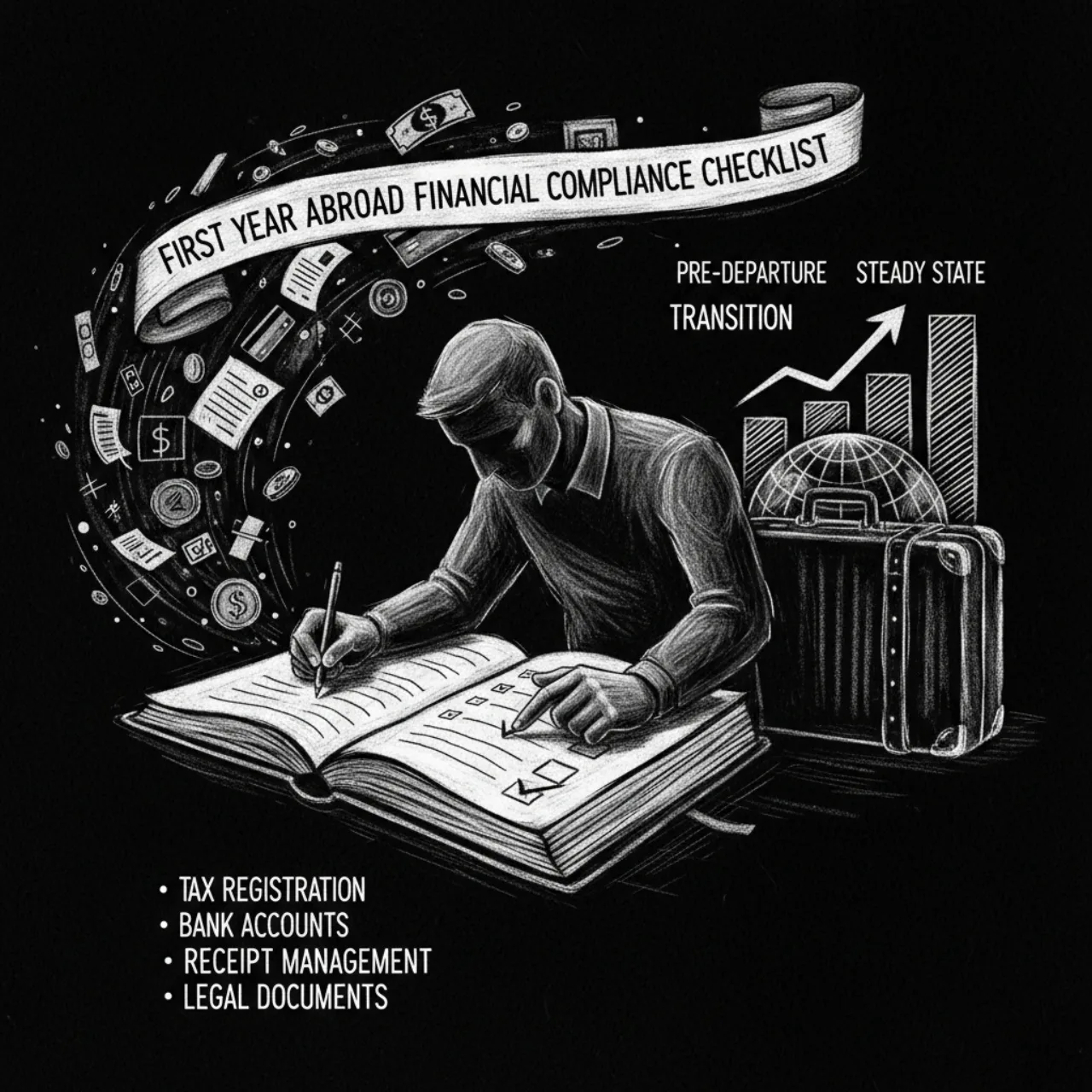
Whether you are relocating from the US, the UK, Canada, or Europe, your first year abroad can feel like a whirlwind of deadlines and unfamiliar processes. Establishing a solid “first year abroad financial compliance checklist” ensures you meet legal obligations and protect your personal finances as you settle into your new location. Below, you will find key considerations to ensure you minimize stress, stay on top of official requirements, and position yourself for long-term success.
If you need more comprehensive guidance for planning your overall move, feel free to explore our move abroad playbook a 2026 guide for internationally mobile professionals.
Gather Proof of Funds
Before you take off, you often need to prove you can cover tuition, living costs, or both for at least your first year. These documents verify you have enough resources to meet local visa or university requirements:
• Bank statements in your name showing adequate balances
• Scholarship or sponsorship letters if you are funded by external sources
• Official student loan statements or disbursement letters
• Sponsorship affidavits accompanied by the sponsor’s financial details
Many countries require a minimum amount to be shown for visa approval, and failing to meet these requirements can lead to denial of admission or visa delays. According to Studee, preparing consistent bank statements over several months and exploring scholarships or loans in advance gives you time to rectify any shortfalls in your funding. [1] If you are self-funding, consider tracking your monthly cash flow in an account dedicated to study or relocation expenses. This helps demonstrate financial stability when authorities review your records.
Comply with Home-country Tax Filing
Even after you leave your home country, you may still need to file tax returns there. For example, U.S. citizens remain subject to American tax laws no matter where they live. The IRS requires foreign account reporting and a federal tax return if you earn worldwide income. [2] If you are from the US, you might qualify for the Foreign Earned Income Exclusion or Foreign Tax Credit, but you must still file a return to claim these benefits. Failure to file can lead to sizable penalties or complications with your passport renewal.
Blueprint Briefing
Notes for the globally mobile.
Selective intelligence on tax, residency, and structures.
By subscribing, you agree to receive Blueprint Briefing emails from Blueprint Group LLC. Unsubscribe anytime. Privacy Policy.
Similar obligations may apply if you are a British, Canadian, or European citizen, depending on whether your home government regards you as a tax resident. Some countries allow you to declare “non-resident” status if you cut most ties. Others require partial-year returns to capture income up to your departure. Consult an international tax advisor if you are unsure, as sorting out your initial tax obligations will keep you in good standing back home.
Register with Host-country Authorities
Once you arrive in your new host country, register with local authorities if that is a requirement. In many places, obtaining a residency permit or similar documentation is essential for legal employment, access to public services, or banking privileges. Different countries have different rules, but common steps include:
- Registering at a local municipality or foreigners’ office
- Demonstrating proof of residency or rental contracts
- Supplying health insurance details or purchasing a local plan
Addressing host-country obligations often requires stable finances as well. You may need bank statements or employment contracts to show you can self-support. In some countries like Canada, Australia, and the UK, you must meet financial thresholds for a visa to remain valid. [1] By addressing these requirements promptly, you preserve your legal status and avoid possible fines or administrative hurdles.
Prepare Foreign Bank Reporting
Keeping your money outside your home country can trigger additional filing responsibilities. U.S. citizens, for instance, must file a Foreign Bank and Financial Accounts Report (FBAR) if their combined foreign accounts exceed $10,000 at any point during the year. [2] You may also hear about the Common Reporting Standard (CRS) if you are from certain European or other jurisdictions that automatically exchange tax data.
At first glance, the reporting forms look daunting. Yet they are not optional. Neglecting them can result in steep penalties. The easy way to handle foreign account reports is to keep comprehensive records of balances in each account you hold overseas. If required, set reminders to file any needed annual disclosures to your home-tax authority.
Manage Your Retirement Accounts
Relocation makes you reconsider how your retirement savings should be managed. Check whether your home-country pension or private retirement plan can be maintained while you live abroad. Many mobile professionals keep existing accounts but must consider eventual double taxation or high foreign fund fees.
In the U.S., for example, you can continue contributing to certain tax-advantaged vehicles under specific conditions. However, watch out for foreign mutual funds classified as Passive Foreign Investment Companies (PFICs) if you open a retirement-style investment account in your host country. [3] If you are uncertain, consult an international financial advisor to help you optimize your retirement portfolio for cross-border regulations.
Build a Financial Safety Net
The first year abroad often brings unexpected costs. From urgent plane tickets home for family emergencies to exorbitant health care bills if local coverage is insufficient, having a robust cushion can be crucial.
Most experts recommend saving around 9 to 12 months of living expenses to protect yourself against volatility. [4] Splitting your funds between stable currencies, such as U.S. dollars and your new local currency, hedges against exchange rate fluctuations. You might also explore an international health insurance plan. Even if you qualify for local public health services, a gap in coverage could leave you financially exposed if the system does not cover all treatments or repatriation costs.
Stay Agile and Informed
Regulations can shift rapidly, and the last thing you want is a compliance issue after you have settled in. Authorities often update student visa rules, heightened documentation requirements, or bank reporting thresholds. To avoid surprises, schedule regular check-ins throughout your first year:
- Keep track of relevant updates directly on government or embassy websites
- Remain in touch with advisors who specialize in expat finances
- Bookmark official pages on tax laws, especially from the IRS or your home revenue agency
- Watch for emails from your university or employer describing new local guidelines
By making small adjustments as needed and consulting experts promptly, you will feel more secure about your residency status, banking matters, and potential tax obligations.
Conclusion and Disclaimer
Your first year abroad introduces novel regulatory requirements that can challenge even the most organized traveler. From gathering proof of funds and establishing local residency to filing accurate tax returns back home, each step demands careful attention. Yet, with the right strategy, you will have a streamlined approach and far less stress.
This article does not replace professional legal, financial, or tax advice. Always discuss your unique circumstances with qualified advisors who understand cross-border regulations. As you refine your first year abroad financial compliance checklist, you lay the groundwork for a rewarding and compliant experience in your new destination.
References
- (Studee)
- (IRS)
- (Creative Planning)
- (Escape Artist)
Strategic Diagnostic
Worth a 30-minute conversation?
A no-charge call to map your priorities, jurisdictions, and the structure that fits.
Map My Strategy →Blueprint Briefing
Strategic notes from the borderless economy.
Hand-picked insights on residency, structures, and global mobility, for entrepreneurs and investors.
By subscribing, you agree to receive Blueprint Briefing emails from Blueprint Group LLC. Unsubscribe anytime. Privacy Policy.
Blueprint Global coordinates international structuring and project-manages the implementation process. We do not provide tax, legal, investment, or immigration advice. All advisory services are delivered by licensed professionals in their respective jurisdictions.
Explore Blueprint's services