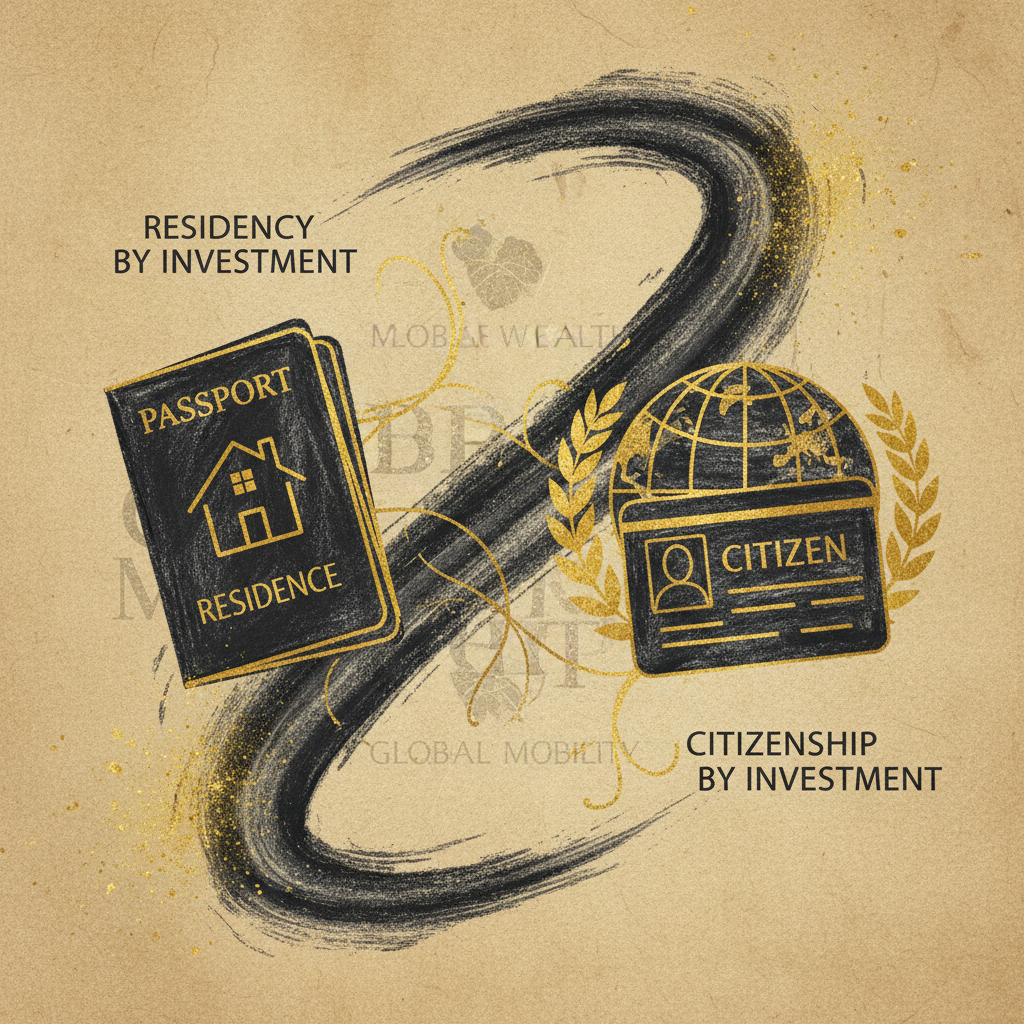
You may be exploring options for global mobility, diversification of your assets, or simply securing a secure future for your family. In this quest, you are likely to come across two common pathways: residency by investment vs citizenship by investment. Each route promises access to new markets, enhanced travel freedom, and potentially advantageous tax regimes, but the underlying differences can significantly impact your goals. Understanding these nuances is key to selecting a strategy that aligns with your priorities.
Whether you seek a permanent “second home” through a residency visa or a brand-new passport through an investment contribution, the decision involves more than just a financial commitment. In the sections below, you will learn how these two models compare, what you should consider for each, and how real-world examples illustrate the possibilities.
Understand Residency by Investment
Residency by investment (RBI) programs grant you the legal right to reside in another country in exchange for specified economic contributions—such as purchasing property, starting a business, or placing funds in government-approved instruments. By acquiring this residency status, you can live, work, study, and often access healthcare and other social benefits. For many individuals, especially those who prefer a “try before you buy” approach, establishing residency is often an attractive first step.
However, RBI status is not citizenship. You generally receive documents like a residence card, which means you keep the passport of your country of origin. Depending on the location, you may have to maintain a minimum physical presence in that territory. As explained in 2024, certain RBI programs in Europe, North America, and parts of Asia-Pacific do require you to spend time in-country to continue renewing your status. [1]
The investment thresholds vary widely. Some countries make it fairly accessible—Greece, for instance, has offered residency with a property purchase starting around EUR 250,000, while the United States EB-5 visa starts at USD 800,000 if you invest in a qualifying project. [2] Meanwhile, you usually need to demonstrate financial self-sufficiency, provide security checks, and renew your permit as dictated by the host nation’s regulations. Over time, many RBI programs have optional or potential pathways to citizenship, but this often involves meeting residency requirements, language exams, or other conditions.
If you are considering a deeper look at modern RBI opportunities, you can also explore our residency by investment a 2026 guide for mobile wealth.
Explore Citizenship by Investment
Citizenship by investment (CBI) programs grant you a new passport and full legal rights in a host country in return for an approved economic contribution. Compared to standard naturalization, which can require years of residency, CBI shortens the path to a matter of months. Some programs in the Caribbean, for example, let you obtain a second citizenship in as little as three to four months via real estate, government donations, or direct business investments. [3]
Blueprint Briefing
Notes for the globally mobile.
Selective intelligence on tax, residency, and structures.
By subscribing, you agree to receive Blueprint Briefing emails from Blueprint Group LLC. Unsubscribe anytime. Privacy Policy.
The primary advantage is that you hold the same rights as any other citizen of that nation. This includes voting rights (depending on local rules), the possibility of running a business, and applying for local bank accounts or insurance. Another key attraction is extensive visa-free or visa-on-arrival travel. Some passports can give you swift entry to over 100 countries. [1] Furthermore, many jurisdictions with CBI do not require you to give up your original passport.
One noteworthy consideration is the financial threshold. Countries that offer CBI typically require a substantial outlay, such as the minimum real estate purchase of $200,000 in Antigua and Barbuda or the multi-million euro contributions that certain European nations used to invite—though some European options have recently closed or changed. [4] You may also want to confirm ongoing obligations after your passport is issued. While most CBI programs do not mandate physical presence, there could be fees and renewal formalities to keep your citizenship valid.
Compare the Key Factors
Below is a concise overview of how residency by investment and citizenship by investment compare across multiple dimensions:
| Factor | Residency by Investment (RBI) | Citizenship by Investment (CBI) |
|---|---|---|
| Legal status | Residence permits, subject to renewal | Full citizenship rights, typically no renewal needed once granted |
| Global mobility | Visa-free travel within certain regions, but can be limited globally | Access to broader visa-free entry, up to 190 destinations in top-tier programs |
| Physical presence | Often must maintain meaningful residence | Usually no mandatory stay requirements |
| Investment timeline | Can be less costly upfront, but may take years to gain citizenship | Larger lump-sum investment, but passport can be granted in a few months |
| Political rights | Limited (cannot vote or hold a passport) | Full rights including voting, subject to local constitution |
| Attachment to country | Encourages familiarity by living there and integrating | May or may not require any local integration |
(Data drawn from 2024–2026 program comparisons. Sources include Henley & Partners and Global Citizen Solutions.)
As you weigh these differences, consider your immediate objectives and long-term ambitions. You might only need the convenience of living in a preferred location without becoming an active citizen, or you may want the security and extended freedoms that a second passport guarantees. Keep in mind that tax obligations, due diligence processes, and local regulations add layers of complexity to either route.
Focus on Real-world Examples
Two notable examples of investment migration pathways are Portugal’s residency program and Malta’s citizenship opportunities. While each now has its own specific conditions, they illustrate how RBI and CBI diverge in practice:
Portugal’s residency pathways
Portugal became a popular RBI hub due to relatively straightforward asset requirements, such as purchasing real estate or contributing to a job-creation fund. If you are comfortable residing in Portugal for a small portion of each year, you have a robust chance of eventually obtaining citizenship after about five years—assuming you have complied with all renewal and language exam requirements. This “golden visa” has historically granted plentiful benefits, like access to the Schengen Area. [2]
Currently, certain changes are under discussion or implementation, so it is important to confirm up-to-date requirements before proceeding.
Malta’s citizenship program
Malta stands out in Europe for offering a pathway to citizenship through significant contributions and investments. Over the years, it has been recognized for its thorough due diligence but also for allowing you to obtain an EU passport more quickly than standard naturalization processes. According to industry reports, successful applicants typically invest in real estate, donate to a government development fund, and satisfy a fit-and-proper test, gaining full citizenship rights in well under the usual time frames. [3]
This program can be an appealing choice if your primary aim is an EU passport with the capacity to live and work freely across Europe. However, the required investments surpass what you would typically put into a residency-only route.
Decide Your Best Path
Your final decision about whether to pursue residency by investment or citizenship by investment depends on the extent of the benefits you want and your appetite for investment commitments. If you expect to relocate or conduct active business in another country, a residency approach could be more suitable. Alternatively, if full global mobility with minimal physical presence requirements is your top priority, a CBI program may be worth the higher price tag.
You should also review your tax situation thoroughly. Holding residency or citizenship in another jurisdiction can shape your fiscal obligations, from personal income taxes to asset declarations. We strongly suggest that you consult qualified professionals, including cross-border tax advisors, financial planners, and legal counsel familiar with the intricacies of each program.
Ultimately, you will want to explore offerings that align with your personal timeline, exit strategies, and family’s plans. Changes to these programs can occur with limited notice. Regions like Ireland and the Netherlands have recently closed certain golden visa pathways, while others—like Greece or Spain—have made adjustments to minimum investment thresholds. [2]
Above all, take a disciplined approach to whichever route you choose. Conduct thorough due diligence, analyze risk factors, and weigh the importance of permanent political rights versus day-to-day convenience. By doing so, you maximize the potential advantages for you and your family, ensuring that your global mobility strategy aligns with your long-term ambitions.
References
Strategic Diagnostic
Worth a 30-minute conversation?
A no-charge call to map your priorities, jurisdictions, and the structure that fits.
Map My Strategy →Blueprint Briefing
Strategic notes from the borderless economy.
Hand-picked insights on residency, structures, and global mobility, for entrepreneurs and investors.
By subscribing, you agree to receive Blueprint Briefing emails from Blueprint Group LLC. Unsubscribe anytime. Privacy Policy.
Blueprint Global coordinates international structuring and project-manages the implementation process. We do not provide tax, legal, investment, or immigration advice. All advisory services are delivered by licensed professionals in their respective jurisdictions.
Explore Blueprint's services